
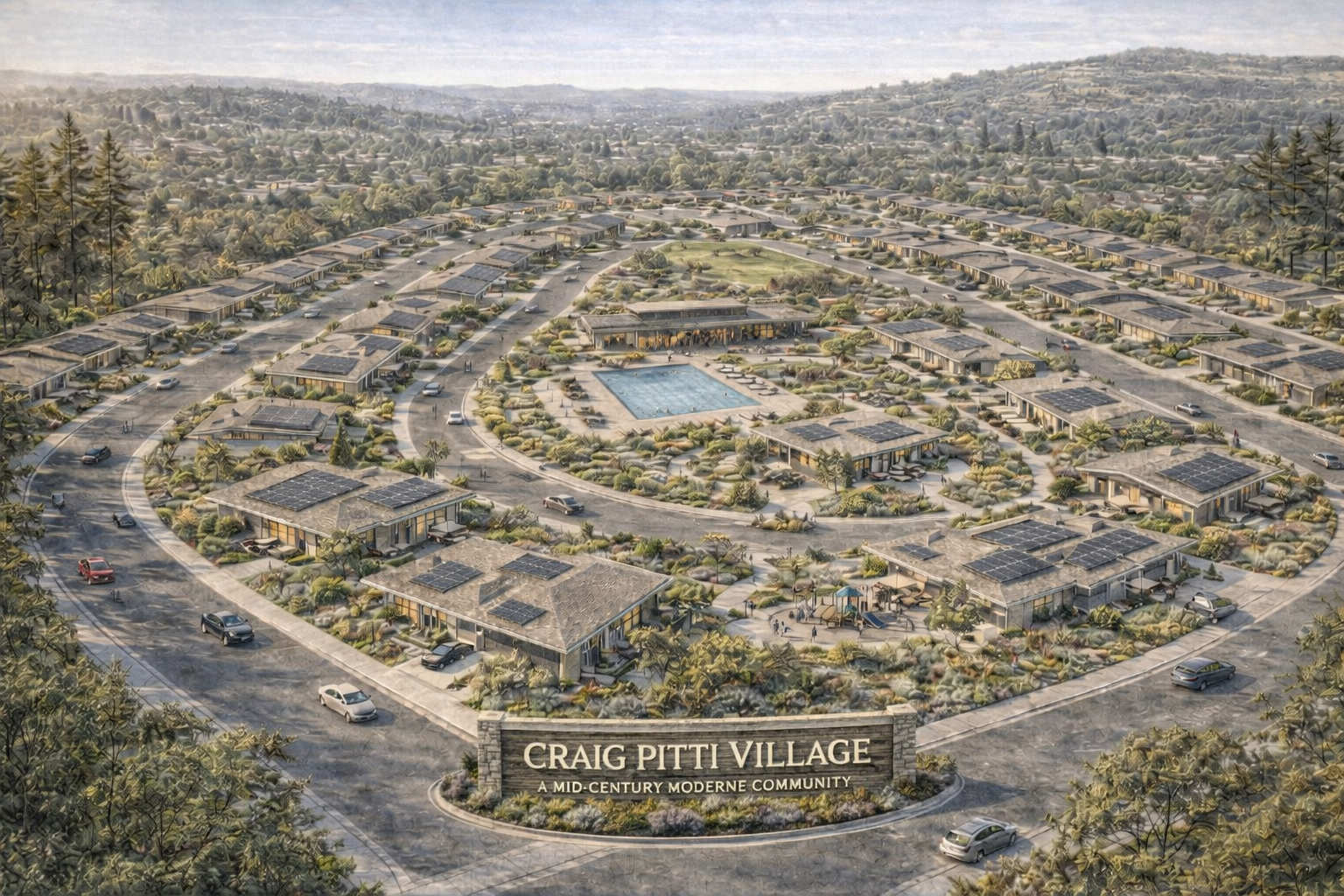
Shared Equity Workforce Housing for Novato Teachers and Civic Workers
I. The Problem: A Workforce That Cannot Afford to Live Here
Novato's median home price reached $1,297,500 in 2024, up 189% since 2000 (Burdell Real Estate, 2024). At current mortgage rates near 7%, a household needs annual income of approximately $304,000 to $390,000 to qualify for a conforming loan on that median home, depending on down payment and debt-to-income assumptions. A starting Novato Unified School District teacher earns $62,355 (EdJoin, NUSD 2025-2026). A starting police officer earns $91,308 (City of Novato Police Officer Posting, 2024). A starting firefighter earns $118,268 (FCTC, Novato Fire Posting 2023). None of these workers, the people who educate Novato's children, protect its residents, and maintain its infrastructure, can afford to buy a home in the community they serve.
The rental market offers no relief. The cheapest one-bedroom apartments in Novato average $2,196 per month (Apartments.com, March 2026). A starting teacher earning $5,196 per month gross would spend 42% of income on that apartment, well above the 30% rent-burden threshold. Two-bedroom units averaging $2,749 per month would consume 53% of the same teacher's gross pay. Marin County's rental vacancy rate sits at 4.3%, and Novato's at 2.3%, far below the 7.4% rate considered stable (CommunityScale, 2026). Ninety-two rental listings serve an entire city (Zillow, October 2025).
The income needed to afford the average Marin County rent without being cost-burdened has doubled in a decade, from $56,000 in 2015 to $112,480 in 2025 (Rooted in Marin Report, April 2025). Fifty-six percent of Marin's renters are cost-burdened, one of the highest shares in the Bay Area (Local News Matters, February 2026). Among extremely low-income households, 67% pay more than half their income on housing (California Housing Partnership, Marin 2025 Report).
The Workforce Consequences Are Already Measurable
The Novato Police Officers Association reported in July 2025 that the department has experienced 90% turnover over ten years, with 33% turnover in the prior year alone (Novato POA, July 14, 2025). Marin County Office of Education Superintendent John Carroll stated it directly: "We'd hire people, and they'd say, 'Oh great, I get to work in Marin.' They'd find out how much it costs to live here, and then they'd go work somewhere else." (CBS San Francisco, March 2026)
Nearly two-thirds of workers employed in Marin commute from outside the county (CBS San Francisco, March 2026). The county's housing stock grew only 1.6% over the past decade, compared to 7.3% statewide (Local News Matters, February 2026). Low-income households are leaving Marin at a net rate of 33.5 more people per thousand than arriving (Rooted in Marin Report, April 2025). Marin's median age is 47.9 years, the oldest in California, and its 65-and-over population has grown 43% since 2010 while its working-age population declines (Local News Matters, February 2026). Sarah Jones, Marin County Director of Community Development, identified the paradox precisely: "Marin cannot stay the same unless we have workforce housing for people who work here." (Marin Magazine, March 2026)
| Worker | Starting Annual Pay | % of Income on 1BR Rent | Income Needed to Buy Median Home | Gap |
|---|---|---|---|---|
| Starting NUSD teacher | $62,355 | 42% | $304,000 - $390,000 | $242,000 - $328,000 |
| Starting police officer | $91,308 | 29% | $304,000 - $390,000 | $213,000 - $299,000 |
| Starting firefighter | $118,268 | 22% | $304,000 - $390,000 | $186,000 - $272,000 |
| Code enforcement officer | $80,995 | 33% | $304,000 - $390,000 | $223,000 - $309,000 |
Assumes $2,196/month 1BR rent; median home $1,297,500 at 7% rate with 10% down, 28-36% DTI rule.
II. Why Rental Subsidies Are Not Enough
Marin County and Novato have historically addressed housing affordability through deed-restricted rental developments, Section 8 vouchers, and inclusionary in-lieu fees. These tools serve essential functions for the lowest-income residents. But for the moderate-income workforce, teachers, firefighters, police officers, and city staff earning $60,000 to $140,000, rental subsidies alone fail to solve the retention problem because they do not create ownership or wealth.
The distinction is not philosophical. It is empirical. A 2023 study by the Lincoln Institute of Land Policy and the National Community Land Trust Network found that shared equity homeowners accumulate a median of $13,774 in housing wealth, compared to just $16 per year for comparable renters, while moving at a rate of 2.6% annually versus 14% for average American households (Lincoln Institute, 2023). Seventy-four percent of shared equity homeowners remained in their homes for six or more years.
Community land trust homeowners also demonstrate foreclosure rates roughly one-tenth those of conventional mortgage holders. During the 2008-2012 housing crisis, CLT homes maintained a foreclosure rate of 0.56%, compared to 3.31% for prime conventional loans and 15.58% for subprime loans (Lincoln Institute, CLT Foreclosure Data). The model produces stability, not dependency.
The Marin County workforce housing pipeline reflects this gap. The 135-unit Oak Hill project near San Quentin, the county's largest workforce housing effort to date, is structured entirely as rental housing. It will serve an essential need. But it will not help a single teacher or firefighter build equity, establish roots, or exit the rental treadmill. The question for Novato is whether to replicate that model or to build something that creates permanent community stakeholders.
III. What Shared Equity Homeownership Is
Shared equity homeownership is a model in which a public or nonprofit entity subsidizes the purchase price of a home in exchange for a permanent restriction on resale price, ensuring the home remains affordable to the next buyer at a comparable income level. The homeowner occupies the unit, builds a defined share of appreciation, and sells under a formula that preserves affordability in perpetuity. Unlike one-time down payment grants or time-limited affordability covenants that expire after 30 or 55 years, shared equity restrictions recycle the public subsidy indefinitely.
Community Land Trusts
A community land trust is a nonprofit entity that acquires and holds land under a 99-year ground lease, permitted under California Civil Code Section 718. The CLT sells the improvements (the house or condominium) to qualified buyers at a below-market price while retaining ownership of the land. The ground lease includes a resale restriction formula that typically allows the homeowner to retain 25% to 50% of any appreciation. When the owner sells, the CLT exercises its option to repurchase and resells to another income-qualified buyer. The subsidy never leaves the system.
California law provides a robust framework for CLTs. AB 1206 (2021) required the Department of Real Estate to develop model ground leases. SB 196 (2019) authorized property tax reductions for CLT homes to reflect their restricted resale value rather than market value, directly reducing the cost of homeownership for CLT buyers. SB 1079 (2020) gave CLTs and other nonprofits right of first refusal to purchase foreclosed properties. ACA-10 (2024) removed Proposition 13 limitations that had prevented affordable housing bond measures from passing at the local level with a 55% supermajority.
Deed-Restricted Shared Equity
Deed restrictions achieve a similar result without a separate landholding entity. A city or county records a covenant against the property title that limits resale price, requires owner occupancy, and defines the equity-sharing formula. Inclusionary zoning ordinances, authorized in California under AB 1505 (2017) and Government Code Section 65850, are the most common source of deed-restricted units. Novato's existing inclusionary ordinance requires 10-20% affordable units in projects of seven or more units, with in-lieu fees funding the city's Housing Trust Fund as an alternative.
The deed-restriction model is particularly well-suited to workforce housing because it can be applied to existing homes acquired from the market, not only to new construction. The Vail InDEED program in Colorado has placed permanent occupancy deed restrictions on over 1,040 existing homes at a cost of 15-20% of fair market value per unit, funded through real estate transfer tax revenue. The restriction converts a market-rate home into permanently affordable workforce housing without building a single new structure.
IV. Precedents: Where Shared Equity Works
Jefferson Union High School District, San Mateo County
Jefferson Union HSD opened 705 Serramonte Boulevard in Daly City in 2023: 122 workforce housing units for educators and staff at approximately 50% of market rents, built on district-owned land. The $75.5 million project was funded through a combination of $33 million in general obligation bonds and $42.5 million in certificates of participation. The district reported zero staff vacancies after the project opened, a direct inversion of the recruitment crisis that motivated the program (KQED, Bay Area School Teacher Housing). The model demonstrated that school districts can act as their own housing developers when they control surplus land.
Casa del Maestro, Santa Clara County
Santa Clara Unified School District developed Casa del Maestro, a 70-unit apartment complex for district employees, in 2002. Rents are set at approximately 80% of market rate. The project was financed with $12 million in certificates of participation. Teachers living at the site showed an annual attrition rate of less than one-third that of their peers who commuted (EdSource, 2018). Casa del Maestro proved that proximity to the workplace, combined with below-market costs, directly drives retention. But as a rental-only model, it does not build equity for residents.
Whistler Housing Authority, British Columbia
The Whistler Housing Authority has operated for 28 years and currently manages 2,213 restricted units, approximately evenly split between rental (1,082) and ownership (1,086), with over 200 additional units in the pipeline at a cost of $105 million. Ownership units use a CPI-indexed resale formula rather than market appreciation, meaning homeowners build real but moderate equity while the program preserves affordability across generations. The program is funded through Crown land contributions, an employee service charge bylaw, density bonusing, and BC Housing grants. Whistler demonstrates that shared equity ownership can operate at meaningful scale in a high-cost resort community with economic dynamics comparable to Marin County.
Vail InDEED, Colorado
Vail's InDEED program has placed permanent deed restrictions on 1,040 existing homes at a total public investment of $12.5 million, averaging $21,000 to $64,000 per unit in restriction costs. The restrictions require owner occupancy and prohibit use as short-term rentals. The program is funded entirely through a 4% real estate transfer tax, which generates approximately $10.4 million annually. The model converts existing housing stock into permanently affordable inventory without new construction.
Irvine Community Land Trust, California
The Irvine Community Land Trust uses a 99-year ground lease with an AMI-indexed resale formula. Its Sage Park development offered 68 homes and attracted 6,053 lottery applicants, a ratio that demonstrates both the depth of demand and the viability of the model in California's regulatory environment (Irvine CLT). The City of Irvine has set a target of 9,700 CLT units, the most ambitious municipal CLT commitment in the state.
| Program | Structure | Units | Funding | Key Outcome |
|---|---|---|---|---|
| Jefferson Union HSD | Below-market rental on district land | 122 | $75.5M (GO bonds + COPs) | Zero staff vacancies |
| Casa del Maestro | Below-market rental, 80% of market | 70 | $12M COPs | 1/3 the attrition rate |
| Whistler Housing Authority | CPI-indexed ownership + rental | 2,213 | Land + levies + grants | 28 years of operation |
| Vail InDEED | Deed restriction on existing homes | 1,040 | $12.5M via 4% RETT | Permanent occupancy |
| Irvine CLT | 99-year ground lease, AMI-indexed | 68 (9,700 target) | City + state + federal | 6,053 applicants for 68 homes |
V. Why Novato Is the Right Pilot
NUSD Has Already Begun
Novato Unified School District is actively pursuing workforce housing on district-owned surplus land. In July 2025, the California State Board of Education approved a Surplus Land Act waiver for NUSD properties including the Meadow Park Annex site and San Andreas site, clearing the path for educator workforce housing development with an estimated 18-to-26-month entitlement timeline (NUSD Educator Workforce Housing). These sites could accommodate 200 or more units. The school district has demonstrated the institutional will to act. What it lacks is a financing and ownership structure that converts that will into permanently affordable homeownership.
The RHNA Compliance Pressure Is Real
Novato's 6th Cycle RHNA allocation requires 2,090 new housing units by 2031, including 570 very-low-income and 328 low-income units (City of Novato Housing Element 2023-2031). As of early 2026, the city has issued approximately 141 building permits total, just 6.7% of its goal, with only 15 permits issued in all of 2025 (Novato Planning Commission APR, February 2026). The city overproduced market-rate housing in the prior cycle (204% of the above-moderate goal) while falling short on very-low-income units (64%). The pattern is clear: Novato builds for the market, not for the workforce. Shared equity homeownership at the moderate-income level would count toward RHNA obligations while serving the workers Novato actually needs to retain.
Opportunity Sites Exist
Beyond the NUSD surplus properties, Novato has identified key development sites in its Housing Element. The Grant Avenue corridor in downtown has two active projects: 56 units approved at 3rd and Grant (June 2024) and 170 units under environmental review at 1st and Grant. The SMART station area offers transit-oriented development potential for workforce housing within walking distance of rail service. Habitat for Humanity has an approved 80-unit affordable homeownership project on Redwood Boulevard near the San Marin SMART station, with a $5.2 million Marin County loan approved in April 2025 and a remaining gap of approximately $20 million (City of Novato Housing Element).
The ingredients exist: surplus public land, an active school district housing initiative, transit-oriented sites, an inclusionary housing ordinance, and a Housing Trust Fund. What is missing is the organizing structure that connects these assets to permanent workforce homeownership.
VI. The Proposed Model: A Novato Workforce Housing Trust
Structure
The proposal is a Novato Workforce Housing Trust structured as a community land trust under California law, governed by a board with representation from the City of Novato, NUSD, the Novato Fire Protection District, and community residents. The Trust would acquire land, either through transfer of surplus public property or market purchase, hold it under 99-year ground leases, and develop or rehabilitate housing for sale to income-qualified teachers, firefighters, police officers, and other civic workers at prices affordable to households earning 80% to 150% of Area Median Income.
The CLT model is preferable to a deed-restriction-only approach for three reasons. First, the ground lease permanently removes the cost of land from the purchase price, typically representing 30-40% of total project cost in Marin County. Second, the CLT's institutional structure provides ongoing stewardship: monitoring resale compliance, managing ground lease terms, and connecting buyers to financing. Third, CLTs qualify for property tax treatment under SB 196 (2019) that assesses the home at its restricted value rather than market value, reducing ongoing costs for homeowners.
Eligibility
Priority eligibility would be limited to active employees of: (1) Novato Unified School District (certificated and classified staff), (2) City of Novato (all departments), (3) Novato Fire Protection District, (4) Novato Sanitary District, and (5) North Marin Water District. Income eligibility would be set at 80% to 150% of Marin County AMI, currently $148,800 to $278,550 for a four-person household based on the 2025 HUD AMI of $185,700. This range captures the vast majority of teachers, first responders, and municipal workers who are priced out of the market but earn too much for traditional affordable housing programs.
Equity Sharing Formula: Example because this is the opportunity to compete in compensation with neighboring agencies at no cost to general fund.
The recommended resale formula would allow homeowners to retain 25% of appreciation upon resale, with the remaining 75% captured by the Trust to maintain affordability for the next buyer. At Novato's historical appreciation rate of approximately 5% per year, a homeowner purchasing at $450,000 (below-market, reflecting land cost removal) who sells after seven years at a restricted price reflecting cumulative appreciation would retain approximately $20,000 to $30,000 in equity, in addition to all principal payments made during ownership. This is modest wealth-building by market standards but transformative compared to the zero equity accumulated by renters.
VII. The Funding Strategy
Per-unit development costs in Novato currently range from $800,000 to $950,000 for new multifamily construction (California Housing Partnership, Marin 2025 Report). The subsidy gap, the difference between total development cost and what a workforce buyer at 120% AMI can afford, ranges from $350,000 to $700,000 per unit before accounting for land cost reduction through the CLT model. Removing land cost through public land transfer can close 30-40% of that gap immediately. The remainder requires a layered funding strategy.
An Enhanced Infrastructure Financing District for Workforce Housing
Government Code Section 53398.52(b)(3) explicitly authorizes "affordable housing" as an eligible EIFD project category. An EIFD encompassing the SMART station area and downtown Grant Avenue corridor could capture the tax increment generated by new development and direct it toward workforce housing construction and subsidy. The SMART station area is particularly well-suited because new development there will generate significant increment over the base year, and transit-oriented workforce housing aligns with state funding priorities under the Affordable Housing and Sustainable Communities program.
West Sacramento's EIFD No. 1, the first in California to issue bonds, sold $57.2 million in tax increment bonds in July 2025 after nine years from establishment to bond issuance. The total timeline underscores why beginning EIFD formation now is the minimum necessary action, not an early one.
The Funding Stack
| Source | Mechanism | Estimated Potential |
|---|---|---|
| EIFD Tax Increment Bonds | TIF over 45-year term (SMART station area) | $15 - 30M |
| Public Land Transfer (NUSD surplus) | CLT ground lease eliminates land cost | $10 - 20M (land value) |
| Marin County Affordable Housing Trust Fund | $50K - $100K per unit loans | $2 - 5M |
| CalHFA Dream For All | Up to $150K per buyer, shared appreciation | $3 - 7.5M (50 units) |
| AHSC (Affordable Housing + Sustainable Communities) | State grants, transit-oriented projects | $5 - 15M |
| Local Housing Trust Fund (LHTF) | State grants, 50% match required | $1 - 5M |
| Federal Home Loan Bank AHP | Competitive grants, CLT-eligible | $1 - 3M |
| HOME / CDBG (via Marin County) | Federal formula grants | $1 - 3M |
| Inclusionary In-Lieu Fees | Novato Housing Trust Fund revenue | $0.5 - 2M |
| Employer Contributions | NUSD, City, Fire District contributions | Variable |
A fully stacked approach targeting an initial 40-to-60-unit pilot on NUSD surplus land could assemble $35 to $60 million in combined public and institutional funding. The EIFD provides the long-term revenue backbone. Public land transfer eliminates the single largest cost component. State and federal programs fill the per-unit subsidy gap. The CLT structure ensures every dollar of public investment remains in the system permanently.
VIII. Comparison: Shared Equity vs. Alternatives
| Feature | Shared Equity (CLT) | Rental Workforce Housing | Down Payment Assistance |
|---|---|---|---|
| Affordability duration | Permanent (99-year ground lease) | Term of regulatory agreement (30-55 yrs) | One-time; expires at sale |
| Wealth building | Yes (25-50% of appreciation) | No | Yes, but no resale restriction |
| Public subsidy recycled? | Yes, every resale | Partially, via rent restrictions | No; subsidy lost at first sale |
| Foreclosure protection | CLT stewardship; 0.56% rate | Landlord manages risk | Standard mortgage risk |
| Retention effect | 74% stay 6+ years (2.6% move rate) | Higher turnover | Moderate |
| RHNA credit | Yes (ownership units at income level) | Yes (rental units) | Typically no |
| New taxes required? | No (if EIFD-funded) | Depends on structure | Depends on source |
IX. Recommendations
For the City of Novato
1 Initiate a feasibility study for a Novato Workforce Housing EIFD in the 2026-27 budget cycle, with the SMART station area and downtown Grant Avenue corridor as the proposed district boundary. The City already conducts tax increment analysis for other purposes; extending that capacity to a workforce housing EIFD pilot is a marginal cost against a significant return.
2 Amend the inclusionary housing ordinance to create a shared equity homeownership option alongside the existing rental and in-lieu fee alternatives. Developers of seven or more units would have the option of partnering with a designated CLT entity to place inclusionary units under ground lease, generating permanent workforce ownership units as a direct product of market-rate development.
3 Direct the City Manager to convene an interagency working group including NUSD, the Novato Fire Protection District, the Novato Sanitary District, North Marin Water District, and the Marin Housing Authority to evaluate joint participation in a shared equity workforce housing program. Each agency faces the same recruitment and retention challenge. A pooled approach distributes risk and increases the eligible buyer pool.
For NUSD
4 Structure the Meadow Park Annex and San Andreas workforce housing projects as shared equity homeownership under a CLT ground lease rather than as rental developments. The Surplus Land Act waiver already secured from the State Board of Education permits housing development on these sites. The question is whether that development builds wealth for educators or merely reduces their rent.
5 Apply to CalHFA Dream For All and the Federal Home Loan Bank Affordable Housing Program for per-unit buyer subsidies. Dream For All provides up to $150,000 per buyer in shared appreciation loans. The FHLBank AHP has explicitly funded CLT projects and awarded $61.8 million in 2024 across its membership.
For the County of Marin
6 Commit Affordable Housing Trust Fund resources to a Novato shared equity pilot. The Trust Fund carried an uncommitted balance of $10.1 million as of March 2025, making loans of $50,000 to $100,000 per unit. A 40-unit Novato pilot would draw $2 to $4 million from the fund, a meaningful but not overwhelming commitment.
7 Include shared equity workforce housing as an eligible project type in the Marin County Subregional Shoreline Adaptation Plan and any future regional housing bond measures. The withdrawn 2024 BAHFA bond proposal had allocated approximately $699 million for Marin County. If a successor measure advances, shared equity workforce housing should be an explicit funding category.
For the State Legislature
8 Expand EIFD housing authority to include explicit workforce housing provisions for moderate-income households (80-150% AMI) in high-cost counties. Current EIFD law authorizes "affordable housing" under Government Code Section 53398.52(b)(3) but does not define income targeting. A statutory clarification confirming that workforce housing for public employees at moderate income levels qualifies would remove ambiguity and accelerate local adoption.
9 Create a state-level employer-assisted housing tax credit for school districts and local agencies that contribute land or funding to shared equity workforce housing programs. AB 926 (2024) provides a 25% credit for donated land value, but the framework should be expanded to include operational contributions and made permanent.