Novato Region Roads and Drainage Deferred Maintenance and the Case for a General Obligation Bond
A County-Led Approach to City and Unincorporated Infrastructure
The Problem: Roads and Drainage Are Falling Apart
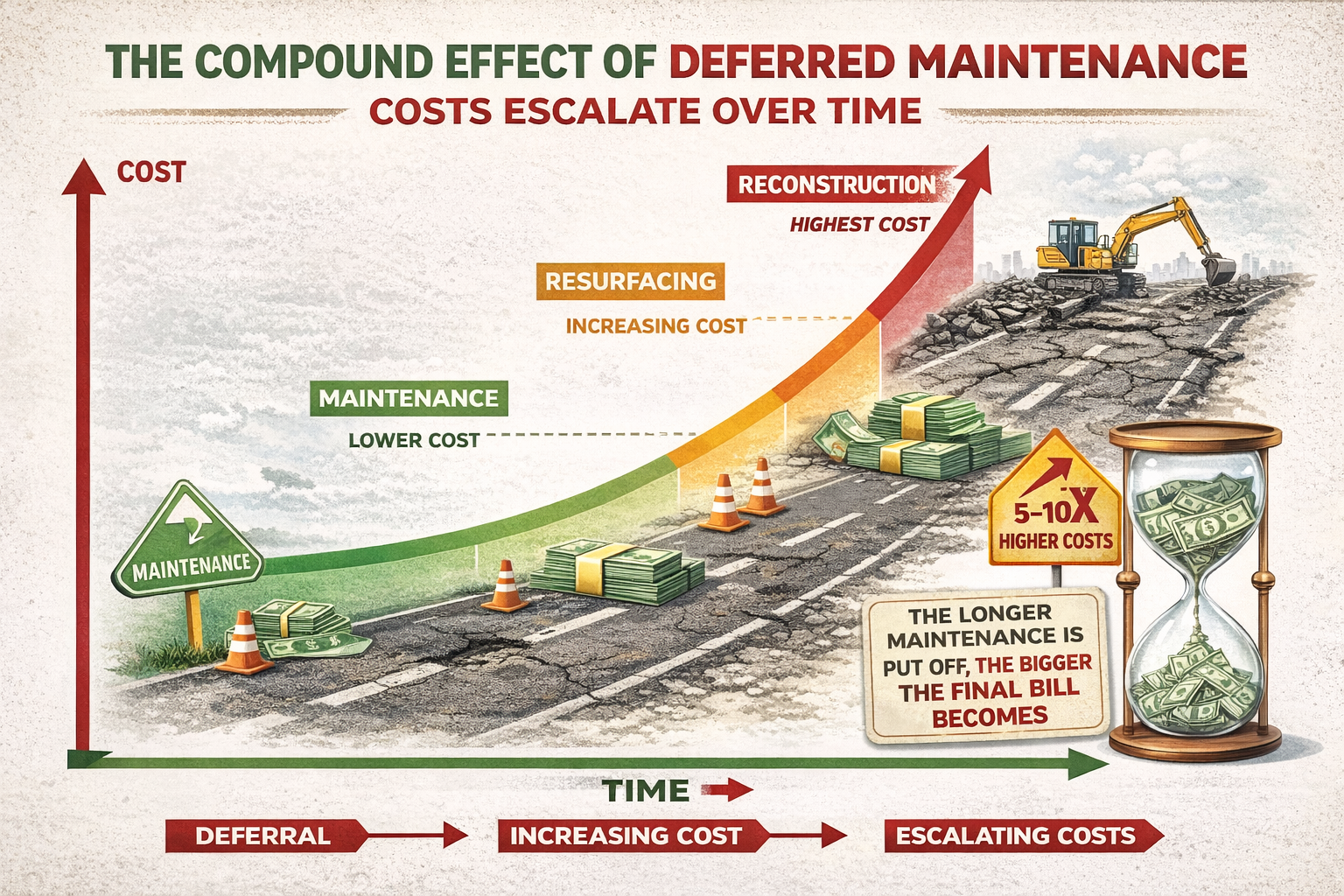
Deferred maintenance is the silent killer of public budgets. It does not make headlines, but the costs quietly build up in the background until they are far higher than what regular, timely upkeep would have cost. When a city skips a $10 preventive treatment on a road today, it faces a $40 to $80 reconstruction bill five or ten years later. The same principle applies to storm drains, culverts, and every other piece of transportation and drainage infrastructure.
Novato has been deferring maintenance on its roads and drainage systems for more than a decade. As City Manager Amy Cunningham stated in October 2024:
“Millions of dollars in deferred maintenance have built up, jeopardizing the City’s long-term financial stability.”
— Amy Cunningham, City Manager, City of Novato, October 2024
The city’s own data tells the story clearly. What follows is a focused look at the road and drainage backlog, what the city is currently spending, why that spending falls short, and what a General Obligation bond could do to close the gap.
The problem is not confined to the city limits. Unincorporated communities surrounding Novato -- Black Point, Green Point, Bel Marin Keys, Loma Verde, Indian Valley, and the Ignacio/Atherton corridor -- depend on county-maintained roads and drainage that face the same pattern of chronic underfunding. Residents in these areas share schools, fire protection, water service, and daily commute routes with Novato. The roads and storm drains do not stop at the city boundary, and neither should the solution.
The Backlog: What the Novato Region Owes Its Roads and Drains
City Roads and Pavement
Novato is responsible for approximately 320 lane miles of pavement with a replacement value of roughly $277 million. The city’s Pavement Condition Index (PCI) currently sits at 66, on a scale of 0 to 100. That sounds middling, but it is right at the edge of a deterioration cliff where conditions can drop rapidly and costs multiply.
Key pavement findings from the July 2024 Council presentation:
- About 40% of roads are in good shape, about half are fair, and roughly 12% are poor or failed
- Deferred maintenance backlog as of July 2024: approximately $40 million (growing by roughly $4 million per year at current funding, likely approaching $47 million by early 2026)
- At current $3 million/year funding, the pavement consultant projected the backlog reaching $61 million by 2029; by 2031 it could exceed $68 million
- To just stabilize at the current PCI of 66 requires $8 million/year
- To return to 2013 conditions (PCI 72) requires $11 million/year and would cut the backlog in half
- To reach best management practices (PCI 80+) requires $14 million/year
Pavement Funding Scenarios
| Scenario | Annual Cost | PCI in 5 Yrs | Backlog in 5 Yrs | Trend |
|---|---|---|---|---|
| Current Funding | $3M | 61 | $61M | Getting Worse |
| Stabilize (PCI 66) | $8M | 66 | ~$40M | Holding Steady |
| Recover (PCI 72) | $11M | 72 | ~$20M | Improving |
| Best Practices (PCI 80+) | $14M | 80+ | Near $0 | Solved |
County Roads in the Novato Region
Road maintenance outside the City of Novato is the responsibility of Marin County. Major access roads to unincorporated areas include Bel Marin Keys Boulevard, Alameda de la Loma in Loma Verde, Harbor Drive in Black Point, Atherton Avenue in Green Point, and Indian Valley Road. The County’s own FY 2025-26 CIP estimates the countywide one-year deferred pavement maintenance backlog at $165 million. The Novato-region share of county roads is estimated at $8 million to $12 million in deferred maintenance.
Storm Drains and Drainage
The City of Novato maintains 144 miles of streets, sidewalks, curbs, gutters, and drainage infrastructure, including 2,350 drainage catch basins and drop inlets, plus 2 storm drain pump stations. Much of this system dates to the 1960s and 1970s and has received only reactive maintenance for years.
In the unincorporated areas, drainage is even more critical. Bel Marin Keys CSD’s lagoon, levee, and drainage systems protect homes from tidal flooding. Black Point and Green Point face recurring storm drainage issues. Aging culverts and undersized pipes across Indian Valley and the Ignacio/Atherton corridor add to the backlog.
A conservative planning-level estimate of the combined city and county drainage backlog in the Novato region is $10 million to $15 million. Aging infrastructure, increasing storm intensity, and sea-level rise pressures on the Bel Marin Keys levee system all point to costs at the higher end.
Combined Roads and Drainage Backlog
| Infrastructure Category | Estimated Backlog | Basis |
|---|---|---|
| Roads and Pavement (City) | $47,000,000 | Documented |
| Roads (County, Novato Region) | $8,000,000 - $12,000,000 | Estimated |
| Storm Drains and Drainage (City + County) | $10,000,000 - $15,000,000 | Estimated |
| TOTAL ESTIMATED BACKLOG | $65M - $74M | |
| If no action, projected 5-year total | $90M - $105M+ | Growing |
Current Spending: Why It Falls Short
The FY 2025/26 Budget
Novato’s FY 2025/26 budget totals $57.7 million. With the addition of Measure M revenue (the 0.75% sales tax increase approved by voters in November 2024), the city allocated:
- $1.8 million additional for the Annual Street Pavement Program
- $6.5 million for new CIP projects (roads and drainage included) and $2.6 million for ongoing CIP projects
- $500,000 from Measure M for two new maintenance positions and core maintenance work
The Math Does Not Work
Measure M brings in roughly $10.3 million per year. That is real money, and it has been critical to preventing further service collapse. But most of it goes to covering the existing structural deficit: staffing, compensation agreements, service restoration, and pension costs. Only a fraction reaches road and drainage capital work.
Even with the additional $1.8 million for paving, total annual road spending is roughly $4.8 million. The city’s own pavement consultant showed that just holding steady at the current PCI of 66 requires $8 million per year. That is a $3.2 million annual shortfall on roads alone, before touching drainage.
Storm drain maintenance receives even less dedicated funding. The city’s two pump stations, 2,350 catch basins, and miles of underground pipe are maintained reactively -- fixes happen after failures, not before. There is no published capital plan for systematic drainage rehabilitation.
The fundamental problem is that ongoing annual revenue, even with Measure M, cannot simultaneously fund day-to-day services and address a multi-decade backlog of deferred road and drainage maintenance. The backlog is a one-time liability that has been accumulating for years. It needs a one-time capital solution.
And none of the Measure M revenue reaches unincorporated areas, where the County’s own road and drainage budgets face similar constraints.
The Solution: A County-Led General Obligation Bond
Why County-Led?
A City of Novato GO bond can only tax property within city limits. It cannot include unincorporated areas, even though residents of Black Point, Bel Marin Keys, Loma Verde, Indian Valley, and the Ignacio/Atherton corridor use Novato roads and drainage infrastructure daily. A county-led bond solves this by covering the entire Novato region -- city and unincorporated alike -- under a single measure.
What Is a GO Bond?
A General Obligation bond is the most common way California cities and counties fund large capital infrastructure projects. It works like a mortgage: the government borrows a lump sum, uses it immediately to fix roads and drainage, and repays it over 20 to 30 years through a small property tax levy on all parcels within the bond area.
Key features of a California municipal GO bond:
- Requires two-thirds (66.67%) voter approval at a general or special election
- Repaid through an ad valorem (based on assessed value) property tax, separate from the 1% base rate
- Can only be used for capital improvements -- in this case, road reconstruction, repaving, drainage repair, and stormwater infrastructure
- Bonds can be issued in series over time as projects are ready
- Subject to independent annual financial audits
- Can include a citizen oversight committee for transparency and accountability
How It Would Work
The process for a county-led Novato region roads and drainage GO bond would follow these steps:
- Pavement and Drainage Assessment: The County commissions a comprehensive assessment of all roads and drainage in the Novato region -- city streets, county roads, storm drains, culverts, pump stations, and levee-related drainage systems.
- Bond Sizing and Feasibility Study: Based on the assessment, the County and its financial advisors determine the right bond amount, term, and estimated tax rate, using the combined assessed value of all parcels in the bond area.
- Board of Supervisors Resolution: The Marin County Board of Supervisors adopts a resolution by four-fifths vote, determining the necessity of the bond and ordering its submission to voters. As of early 2026, District 5 Supervisor Eric Lucan serves as Board President and has listed “investing in community infrastructure” as a top priority. Lucan is running for State Assembly in June 2026, meaning the District 5 seat will have a new Supervisor -- making the 2026 election a pivotal moment to elect someone who will champion a regional roads and drainage bond.
- Joint Planning with City: The City of Novato and the County agree on a project list and spending allocation, ensuring both city and county road and drainage needs are addressed proportionally.
- Ballot Measure: The bond goes before all voters in the Novato region at a general election (November even-year preferred for higher turnout). Must include a project list and tax rate statement.
- Two-Thirds Approval: Voters must approve the bond by a supermajority of 66.67%. (Prop 5, which would have lowered this to 55%, was rejected by California voters in November 2024.)
- Issuance and Construction: Once approved, bonds are sold in series as projects are ready. Construction begins on the worst roads and most critical drainage failures first.
- Oversight and Audits: Annual independent financial audits. A citizen oversight committee reviews all expenditures.
Two Paths Forward
The Novato region faces a clear choice on its roads and drainage. The numbers below are based on the combined assessed value of approximately $16.25 billion across roughly 22,870 households in the city and surrounding unincorporated communities.
As one analysis put it: “If Measure M fails...damage to roads will likely require a bond measure to mitigate.” Measure M passed, but it cannot do the job of a bond. Sales tax revenue is ongoing revenue for ongoing costs. The deferred road and drainage backlog is a capital liability that needs capital financing.
Making It Work: Accountability and Oversight
A GO bond is a serious commitment of public money. Novato-area residents have every right to demand strong guardrails. A well-designed bond measure should include:
- A specific, published project list tied to a professional pavement and drainage assessment, so voters know exactly which roads and drainage systems they are paying to fix.
- An independent citizen oversight committee with real authority to review expenditures and report to the public.
- Mandatory annual independent financial audits of all bond spending.
- Public online dashboards showing project status, costs, and timelines in real time.
- Competitive bidding and professional project management to ensure construction dollars are spent efficiently.
- A lifecycle maintenance plan embedded in the bond program, so the region does not repave roads today only to defer their maintenance again tomorrow.
- Compliance with Marin COST’s Bond Measure Guidelines, including sizing the bond to the documented need (not the maximum allowed by law), full disclosure of per-household costs in ballot materials, and an accountability section identifying prior bond measures and their outcomes.
- A formal intergovernmental agreement between the City and County defining road and drainage project allocation, spending priorities, and governance of bond proceeds.
Novato has some precedent with bond-financed infrastructure. The Hamilton Community Facilities District (CFD) issued bonds in 1995 to build roads, storm drains, parks, and a levee in the Hamilton Field area, and that debt has been fully repaid. A region-wide roads and drainage GO bond would apply a similar principle, spread across the entire Novato area.
Next Steps
- Commission a comprehensive, region-wide pavement and drainage condition assessment. Cover city streets, county roads, storm drains, culverts, pump stations, and levee-related drainage across the entire Novato area. This is the factual foundation for any bond discussion.
- Engage bond counsel and a financial advisor. Size the bond based on actual combined assessed values and current rates.
- Coordinate with the District 5 Supervisor. The June 2026 election will determine who represents District 5. The next Supervisor should make a regional roads and drainage bond a defining priority.
- Test voter appetite. A community survey covering both city and unincorporated residents would gauge support and identify which roads and drainage projects are the highest priority.
- Follow the Marin COST framework. Design the bond to meet their published guidelines from the start.
- Target the November 2028 ballot. A presidential election year maximizes turnout, which helps bond measures reach the 2/3 threshold.
- Design accountability from the start. Write oversight, audits, and lifecycle maintenance into the bond language.
The bottom line is straightforward: the Novato region’s roads and drainage -- city and unincorporated alike -- have been underfunded for more than a decade. The backlog is real, documented, and growing. Annual revenue, even with Measure M, cannot close the gap. A county-led General Obligation bond covering the entire Novato region is the most direct, most equitable, and most cost-effective way to fix the roads and drains, share the cost fairly, and avoid passing an even larger bill to the next generation.
At roughly $14 to $18 per month for the median home, this is an investment the Novato region can afford. The question is whether it can afford not to make it.